What does
professora mean?
My students call me professora. It’s the first Portuguese word a lot of them learn, and it’s a good one to start with — because in English, it gets misunderstood in a very specific way. Let’s fix that. Aula grátis.
Same word, two languages,
two very different jobs.
Portuguese and English both got professor from the same Latin root, and then quietly walked it in opposite directions. In Brazil it stayed ordinary. In English it climbed the career ladder. That gap is worth naming out loud, so nobody has to guess what I am.
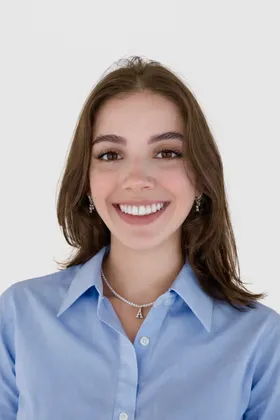
In English, 'professor' usually means university faculty — and I'm not a university professor. I'm a professora: a professional Portuguese teacher with a degree in Language Education, a master's in Portuguese linguistics in progress, and nearly 2,000 lessons taught since 2020. In Brazilian Portuguese, that's exactly what the word means.
That’s the whole disclaimer. Now the fun part — because professora is a genuinely useful word, and by the end of this page you’ll own it in all four of its forms.
Portuguese nouns for people
have a gender.
Professor is one of the cleanest examples in the language. One word, four forms, and the rule behind them is the same rule you’ll use for hundreds of other nouns: -a for feminine, -s for plural. Learn it here and you’ve quietly learned it everywhere.
| The form | Say it like | Who it means |
|---|---|---|
| professor masculine singular | “pro-feh-SOHR” | One male teacher. O professor chegou. — The teacher arrived. |
| professora feminine singular | “pro-feh-SOH-rah” | One female teacher. This one is me. A professora é brasileira. — The teacher is Brazilian. |
| professores masculine or mixed plural | “pro-feh-SOH-rees” | Teachers — all men, or any group with at least one man in it. |
| professoras feminine plural | “pro-feh-SOH-rahs” | Teachers — all women. |
Listen to what the -a does
In professor, that final R sits at the end of the word. In professora, adding the -a drops the R between two vowels — and it turns into a light tap of the tongue, close to the dd in the English word “ladder.” Same letter. Completely different sound. Portuguese does this constantly, and it’s one of the first things I’ll tune in your ear.
The mixed-group rule
Nine female teachers and one male teacher are, grammatically, professores. One man flips the whole group masculine. Students find this rule irritating — honestly, fair — but it’s consistent, and consistent is learnable. You’ll never have to think about it twice after a few weeks.
Brazilians say it
to your face.
Professora, in Brazil, isn’t a job title you’d find on a résumé — it’s a form of address, used out loud, all day long. That’s the part that surprises English speakers most. Children shout it across a classroom. Adults use it in a Google Meet window. It sits somewhere between “Ms. Silva” and “Coach” in English, and it carries warmth and respect at the same time. There’s no clean English equivalent, which is exactly why it’s worth keeping in Portuguese.
| In Portuguese | Say it like | When you’d hear it |
|---|---|---|
| Oi, professora! | “oy, pro-feh-SOH-rah” | The everyday hello. This is how my students open almost every lesson. |
| Bom dia, professora. | “bohng JEE-ah, pro-feh-SOH-rah” | A notch more formal. Good morning — and still perfectly friendly. |
| Tenho aula com a professora. | “TEH-nyoo OW-lah kohng ah pro-feh-SOH-rah” | “I have class with the teacher.” Talking about her, not to her. |
| Ela é minha professora de português. | “EH-lah eh MEE-nyah pro-feh-SOH-rah jee por-too-GEHS” | “She’s my Portuguese teacher.” The sentence I’d most like you to be able to say. |
| Prof. / Profa. | “pro-feh-SOHR” / “pro-feh-SOH-rah” | Written abbreviations only — Prof. masculine, Profa. feminine. You write them, you never say them. Out loud, always the full word. |
One small honesty note about that pronunciation column: I’m a carioca, born and raised in Rio, and cariocas push the final S toward a “sh” sound — portuguêsh. Charming, and completely regional. What you see above is standard Brazilian Portuguese, understood everywhere from São Paulo to Belém. That’s what I teach. You’ll pick up my accent for free if you want it.
Professora is a description
of the training, not a nickname.
Anne Caroline earned the word the ordinary Brazilian way: by training to teach, then teaching. The Language Education degree is completed — that is formal study in how people actually acquire a second language, how to diagnose the error underneath a mistake, and how to sequence grammar so it lands in the right order instead of all at once. A master’s in Letras (Portuguese linguistics) is in progress, underway right now, not finished. And a Language Teaching Certificate followed in 2025.
Then there’s the record, which is the part that isn’t an opinion. 1,956 one-to-one lessons taught since 2020. 49 reviews, every one of them five stars, zero negative ratings. Those lessons and reviews were earned between May 2022 and February 2026 on my original Preply profile; that profile is no longer online, and the Internet Archive captured the complete record on February 6, 2026. Every review is republished on this site, word for word, with the students’ real names and faces.
So when a student types “Oi, professora!” into the chat before a lesson, they’re not being cute. They’re using the correct word, in the correct language, for exactly what I do. It just happens to also be the warmest word in my professional vocabulary — and I’ll take that.
Read all 49 verified reviews →
There is more than one
Anne Caroline.
Anne Caroline is a common Brazilian name, and a search engine will happily hand you several of us — including academics with real university appointments and published papers. Good for them. None of them are me.
The Anne Caroline on this site is the one who teaches Brazilian Portuguese one-to-one over Google Meet from Rio de Janeiro, holds a completed Language Education degree, is currently pursuing a master’s in Letras, and has taught 1,956 lessons since 2020. No university post. No PhD. No faculty page anywhere. If a page describes an Anne Caroline who has any of those things, you’ve found someone else — and you should probably say olá to them too.
In Portuguese, all of us would be called professora. That’s the beauty of the word, and the reason it needed a page of its own.
You just learned a word.
Come use it.
Professora is one word down, with a whole language to go — and the next ones are much easier to learn out loud than on a page. Book a single 50-minute lesson, open with “Oi, professora!”, and we’ll take it from there. If it’s not right for you, I’ll refund your first lesson, no questions asked.
$40 for a single 50-minute lesson · Google Meet · First lesson backed by a money-back guarantee